
Air Duct Cleaning Cost Guide: What Salt Lake City Homeowners Pay in 2026
A $99 coupon and an $800 estimate can both be honest prices for “duct cleaning.” They’re just not pricing the same job. One is a surface pass with a shop vac on a hose; the other is a whole-system mechanical cleaning with negative pressure and containment. The gap between those two numbers is where Salt Lake City homeowners get burned, and it’s the reason a quote sheet is worth more scrutiny than the price printed on it. This guide decodes what sits inside each price tier so you can compare apples to apples.
If you’d rather have someone walk your system and put a flat number in writing, call (866) 937-7589. Estimates are free.
Why do Salt Lake City duct cleaning quotes vary so much in 2026?
They vary because companies are quoting different scopes under the same three words. A quote is really four decisions bundled together: how much duct gets cleaned, with what equipment, how the debris is contained, and whether anyone verifies the work afterward. Change any one and the price moves – sometimes by hundreds of dollars.
There’s also a real cost floor. Truck-mounted negative pressure systems pull several thousand CFM and cost real money to buy, run and maintain. Portable units and consumer-grade rigs cost far less and take longer to do less. That equipment delta alone explains a big chunk of the spread. In our experience, a low headline number is usually a signal that one of those four decisions was quietly skipped.
Salt Lake City adds its own wrinkle. Winter inversions trap fine particulate in the valley, and a lot of it settles into return ducts over a season. Homes here also run furnaces hard for months, so a system that was clean in fall is working harder by February. That doesn’t automatically mean you need annual cleaning – it means the scope of the job matters more than the frequency salespeople push.
What actually drives the price? A line-item breakdown
Four inputs do most of the work in any honest quote:
- Linear footage of ductwork. A compact bungalow and a sprawling two-story with long trunk runs are different jobs. Footage, not square footage, is what a technician measures.
- Number of supply and return registers. More registers means more branch runs, more access points, and more time per system.
- Equipment type. Truck-mounted negative pressure versus portable. Rotary-brush extraction versus a straight vacuum pass. This is the single biggest price lever.
- Add-ons. Sanitizing, duct sealing, and dryer vent cleaning are separate line items, not free throw-ins.
Ask any Salt Lake City company to break the quote into those four buckets. A real scope will survive the question. A bait-and-switch quote tends to get vague fast.
What does professional-grade equipment have to do with the price?
Everything, and it’s the part homeowners never see on a quote sheet.
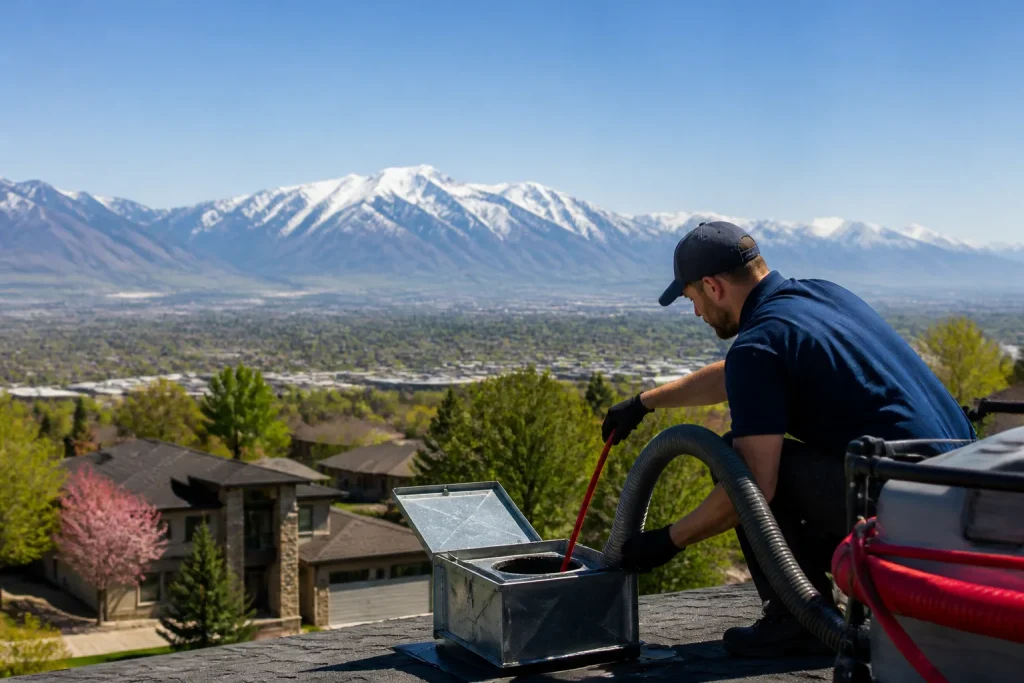
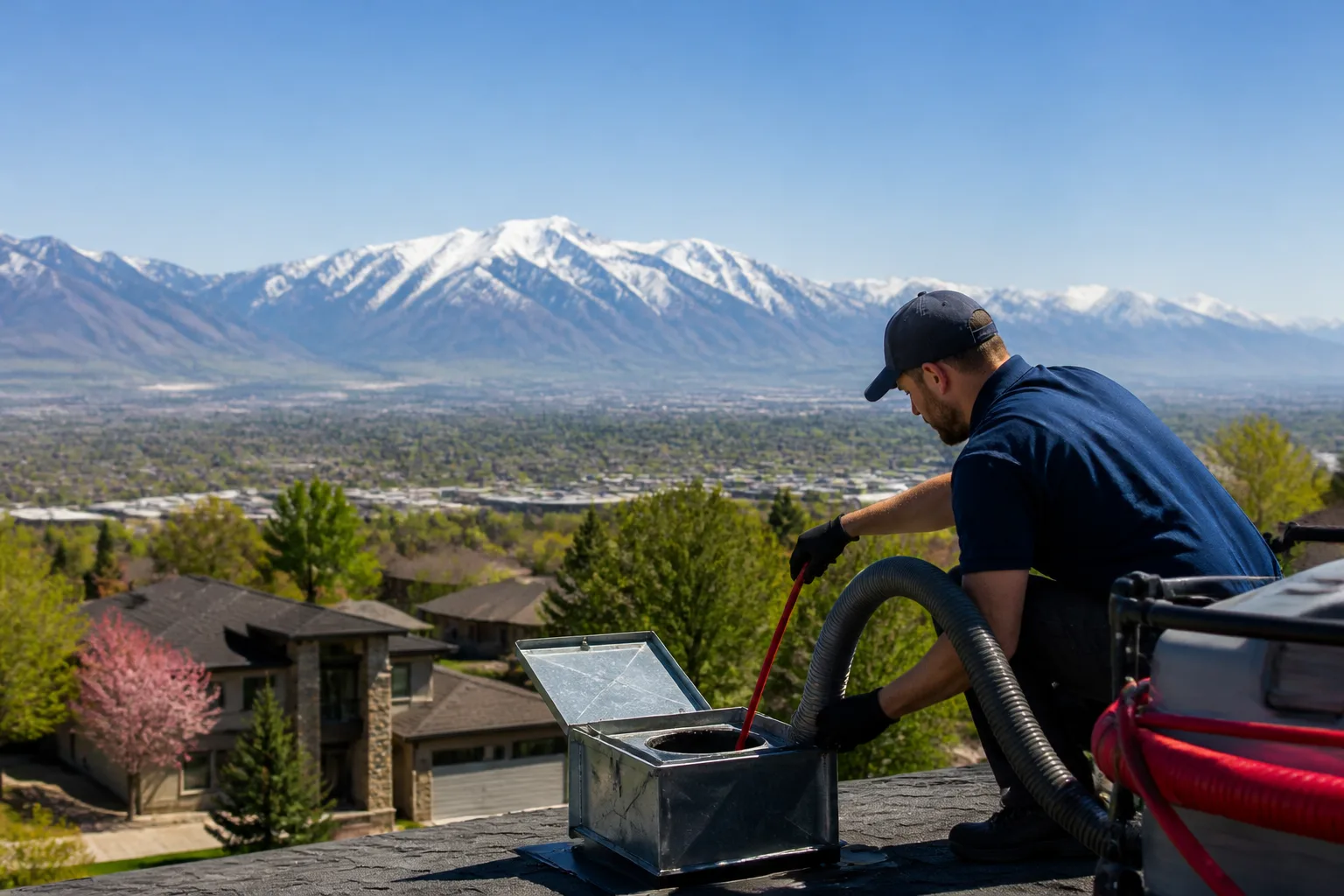
Negative pressure systems keep the duct under vacuum while brushes disturb the debris, so dislodged material travels to the collection unit instead of into your living room. That’s the whole point of the setup, and it’s why the equipment costs what it does. We use Rotobrush rotary-brush extraction, Nikro HEPA-rated vacuum systems that capture particles down to 0.3 microns, and Abatement Technologies air scrubbers – the same remediation-grade technology used in professional restoration work. Holding that standard on every job is a real operating cost, and it sets the floor under a legitimate price.
A shop vac and a hose can look like duct cleaning in a photo. It can’t hold negative pressure, and it can’t capture fine particulate. When a quote lands well under the market, this is usually where the difference lives.
For a closer look at the full mechanical process, see our page on air duct cleaning.
Why is “per vent” pricing a trap?
Per-vent pricing turns a fixed job into an open-ended one. The advertised number covers a small base count; the invoice grows with every register the technician finds once they’re inside. You can’t verify the count from the ad, and by the time the work starts the price is already moving.
The cleaner model is a flat price per system, agreed before any work begins, based on the actual scope. That protects you and it forces the company to scope honestly up front. If a Salt Lake City quote is built per vent, ask for the flat system price instead. If they can’t produce one, that’s your answer.
The other question worth asking: how do I know the work was actually done? Professional crews take before-and-after photos of your own ducts. Ask to see them at the end. It costs nothing and tells you more than any verbal assurance.
2026 price benchmarks for Salt Lake City, with add-ons
Here’s how the market shakes out for a typical Salt Lake City home in 2026:
| Service | Typical estimated range | What it covers |
|---|---|---|
| Full-system duct cleaning (flat rate) | $400 – $800 | All supply and return runs, mechanical cleaning, negative pressure, before-and-after photos |
| Sanitizing / antimicrobial treatment | $150 – $350 | Applied after cleaning; addresses odor and microbial growth on duct surfaces |
| Dryer vent cleaning | $120 – $250 | Lint removal from vent run; a fire-safety service, not a duct add-on |
| Duct sealing (Aeroseal or equivalent) | $800 – $1,800 | Seals leaks in the duct system; priced by leakage reduction and system size |
These are typical estimates, not quotes. Your written estimate sets the final price. Two Salt Lake City homes on the same street can land at opposite ends of a range depending on footage, register count, and access. Duct sealing often runs higher than people expect because it’s a repair, not a cleaning – it fixes the structural cause of contamination and energy loss rather than surface-cleaning around it. Clean ducts are only half the solution; sealed ducts are the other half.
If your dryer vent is due as well – and it’s one of the most-skipped safety items in any home – start with dryer vent cleaning as its own line item.
Does a quote include verification, or just a cleaning pass?
This is the question most homeowners never ask, and it separates a real scope from a cheap one. A mechanical cleaning pass moves debris. Verification proves it’s gone.
Look for one of two things in the quote: a post-cleaning camera inspection of the main runs, or a pressure/airflow check that shows the system is flowing properly after the work. Either one tells you the job was completed, not just started. A quote with neither is asking you to trust the invoice over the evidence.
Ask for the verification method in writing before you book. In our experience, the answer separates the companies that treat duct cleaning as a technical service from the ones treating it as a coupon funnel.
When to call a pro
You don’t need a professional for every dusty register. You do when the signs point at something a vacuum can’t fix. Call a pro if:
- You’ve had recent renovation, pest, or moisture issues that could have pushed debris into the system
- You’re seeing visible debris or mold-like growth at registers
- Airflow is uneven room to room, which often points at duct leakage rather than dirt
- Someone in the home has allergies or respiratory sensitivity that seems tied to the HVAC cycle
- A dryer is taking longer than usual to dry a load
That last one is a fire-safety issue, not a convenience one. And if your filter and register cleaning isn’t improving the air, the problem is likely in the HVAC cleaning scope: the blower, coil, and cabinet are part of the system too. One call covers your ducts, dryer vent, and air quality as a single visit when you want it done together.
For the full picture of our services and how they fit together, start at Salt Lake City Air Duct Cleaning Pros.
The Bottom Line
The 300% spread in Salt Lake City quotes isn’t market chaos – it’s scope. When you compare quotes, compare footage, registers, equipment, containment, add-ons, and verification side by side. A flat price per system, agreed before work starts, with before-and-after photos at the end, is the structure that protects you from the bait-and-switch model. Cheaper isn’t wrong. It’s just usually a smaller job than you thought you were buying.
If you’re in Salt Lake City and need help, Salt Lake City Air Duct Cleaning Pros offers free estimates – call (866) 937-7589. We answer 24/7. Fast dispatch from 7am to 7pm, Sunday through Friday.
Frequently Asked Questions
Full-system duct cleaning in Salt Lake City typically runs $400 to $800 for a flat-rate job covering all supply and return runs. Sanitizing, dryer vent cleaning, and duct sealing are separate line items with their own ranges. The written estimate sets the final price. Call (866) 937-7589 for an exact quote – estimates are free.
Cheap quotes usually skip one of four things: full footage, professional negative-pressure equipment, proper containment, or post-cleaning verification. Per-vent pricing also inflates the final invoice once the technician counts registers on site. Ask for a flat system price in writing before booking. Call (866) 937-7589 if you want a scoped estimate – it’s free.
Ask for before-and-after photos of your own ducts, and ask whether the quote includes a post-cleaning camera inspection or pressure/airflow check. A professional crew expects both requests. If a company hesitates, that tells you something. Call (866) 937-7589 to talk through what verification we include.
There’s no fixed calendar answer. Homes near heavy renovation, pets, or moisture issues may need it more often than a clean, well-filtered home. Salt Lake City’s winter inversions push more particulate into return ducts, but that’s a reason to inspect rather than a reason to schedule annually on autopilot. Call (866) 937-7589 for an honest read on your system – estimates are free.
Written by the team at Salt Lake City Air Duct Cleaning Pros.
Need Air Duct Cleaning Help?
Call Salt Lake City Air Duct Cleaning Pros - the local pro we connect you with is licensed and insured, here with fast help in Salt Lake City.
(866) 937-7589