
Top Signs You Need Air Duct Cleaning Service – Don’t Ignore These
Dust on your return grille is one of the least reliable indicators of dirty ductwork. It mostly tells you that you have air moving through a grille, which is true of every functioning HVAC system. The signs that actually matter are mechanical: how long your system runs, how evenly it heats and cools, and what your energy bills are doing. Here’s how to read those signals in Salt Lake City, and when it’s time to call.
If you’d rather have a technician read them for you, call (866) 937-7589.
What Are the Mechanical Signs Your Ducts Need Attention?
The most reliable signs of duct restriction are performance changes you can observe without opening a wall: longer heating and cooling cycles, room-to-room temperature spread, and energy bills climbing while your thermostat settings stay the same. These point to airflow that has degraded, not to a layer of dust you happen to see.
Here’s what to track over a few weeks:
- Run cycles. If your furnace or AC used to satisfy the thermostat in 12 to 15 minutes and now runs 25 to 30, that’s roughly double the runtime for the same job. Some of that could be weather. If it holds steady across mild and cold weeks, look at airflow.
- Room temperature spread. Put a thermometer in three rooms and check them within ten minutes of each other. A 3 to 5 degree spread between the room above the furnace and the far bedroom is normal in most Salt Lake City homes. A 7 to 10 degree spread usually means a trunk or branch run is restricted or leaking.
- Rising bills. Compare the same billing month year over year with your thermostat schedule unchanged. A jump of 15 to 20 percent with no rate change is worth investigating.
- Static pressure. A technician can read total external static pressure at the air handler. Most residential systems are designed to run under about 0.5 inches of water column. Readings well above that are a measurable restriction, not a guess.
None of these proves the ducts are dirty on their own. They tell you airflow is compromised, and then the diagnostic work starts: filter condition, duct leakage, damper position, and blower condition all get checked before anyone climbs into the attic.
How Do You Test Airflow at the Register?
The tissue test is a quick, free way to see whether a specific register is moving the air it should. Tape a single-ply tissue to the face of the supply register and watch what it does for thirty seconds while the system runs on high.
What the results suggest:
- Tissue blows out at a clear angle. Airflow at that register is fine. Cleaning probably won’t change that room’s comfort.
- Tissue flutters weakly or falls. That run is restricted, blocked, or disconnected. It could be debris, a closed damper, a crushed flex run, or a failed blower. Cleaning fixes the first, not the rest.
- Tissue gets pulled toward the register. That’s a return, not a supply. Returns should pull hard. A weak return often means a filter loaded past usefulness or a collapsed return duct in the attic.
- Tissue stays flat. You likely have a damper closed somewhere or a broken run feeding that register.
Run the test on every register in the house and write down the results with the room name. That list tells a technician more in five minutes than an hour of poking around. In our experience around Salt Lake City, the homes with the widest difference between best and worst register are usually the ones with genuine duct problems rather than just surface dust.
This is a good moment to check the filter too. A filter that’s loaded past its rated change interval is the most common cause of weak airflow, and it’s a maintenance item, not a duct-cleaning issue.
Why Utah Events Matter More Than the Calendar
In Salt Lake City, duct cleaning is usually event-driven rather than calendar-driven. The two events that matter most are summer wildfire smoke and winter inversion, both of which push fine particulate into homes that would otherwise be sealed against it.
During a heavy smoke season, fine ash and combustion particles get drawn into the return system and settle on the interior of the ductwork, on the blower wheel, and on the evaporator coil. Winter inversion does the same thing with trapped particulate, only over weeks instead of days. By the time the season clears, the system has accumulated material it won’t shed on its own.
Event-based triggers in Salt Lake City to note:
- Post-wildfire-smoke season. If your area had a sustained smoke event, look at the return-side filter and the blower compartment a month later.
- Post-inversion winter. A long stretch of trapped particulate means more loading than a normal winter.
- Post-renovation. Drywall dust, sawdust, and insulation fibers from even a small remodel migrate into the return system within days. This is the single most common reason we get called out.
- Post-pest or post-moisture issue. Rodent activity in attic ductwork, or a slow leak that dampened the insulation around a run, both create conditions where cleaning and inspection go together.
- Roof replacement, chimney work, or attic insulation. All of these push debris into ducts that run through the attic.
None of these are on a schedule. They’re triggers. Treating the calendar as the signal instead of the event is exactly how homeowners end up paying for a cleaning that isn’t needed, or skipping one that clearly is.
What Do Odd Smells From the Vents Actually Mean?
A musty smell from the vents usually points to moisture in the system, and a burning smell usually points to heat, not dirt. Both are diagnostic clues that require tracing the source rather than jumping straight to a cleaning.
Here’s how a technician distinguishes the three common locations:
- Musty, in the ductwork. Damp insulation, a disconnected run in a humid crawlspace, or condensation on a cold duct in summer. The smell appears only when the system runs and fades when it stops. Cleaning plus sanitizing addresses the ductwork itself. Fixing the moisture source is what keeps it from coming back.
- Musty or sour, at the coil. The evaporator coil sits wet for much of the cooling season. A clogged condensate drain or a coil that stays wet between cycles will grow biological material, and that smell arrives with every call for cooling. This is a coil cleaning problem, and it’s why full HVAC cleaning, not duct cleaning alone, is often the right scope.
- Burning or hot-plastic, at the heat exchanger. This one is not a cleaning issue. A burning smell at the start of the heating season can be dust burning off the heat exchanger, which clears in a few minutes. A burning smell that persists, or returns mid-season, warrants a technician checking the heat exchanger before anything else. If anyone in the home is having headaches or flu-like symptoms that clear when they leave, shut the system off and get it looked at.
We’ve found that homeowners often assume the fix is duct cleaning when the source is the coil or the blower. A quick inspection answers the question before any work is scheduled. If a burning smell is persistent, don’t burn candles to cover it.
Why Allergy Patterns Beat Seasonal Allergies as a Signal
Allergy symptoms that track with your HVAC running are a stronger signal of an indoor air-quality problem than general seasonal allergies. The pattern to watch is whether symptoms appear or worsen during the hours the system is actively heating or cooling, and improve when it’s off.
Someone with a pollen allergy reacts to outdoor exposure and typically sees symptoms ease indoors with windows closed. Someone reacting to what’s in the ductwork tends to notice symptoms indoors, in specific rooms, and often right after the system kicks on. Those are two different problems and they call for two different solutions.
How to document the pattern before you call:
- Note the time of day symptoms start and stop. Compare it against your thermostat’s runtime log if it has one, or note when you hear the system running.
- Note which rooms. If the same two rooms trigger symptoms and the rest of the house is fine, that’s a room-specific airflow or duct issue, not a whole-house problem.
- Note the response to the system. If symptoms reliably pick up in the ten minutes after the system starts, that’s a useful clue for a technician.
- Note the response to a filter change. If a fresh high-MERV filter helps for a week and the symptoms return, the filter is capturing what it can but the source is still in the system.
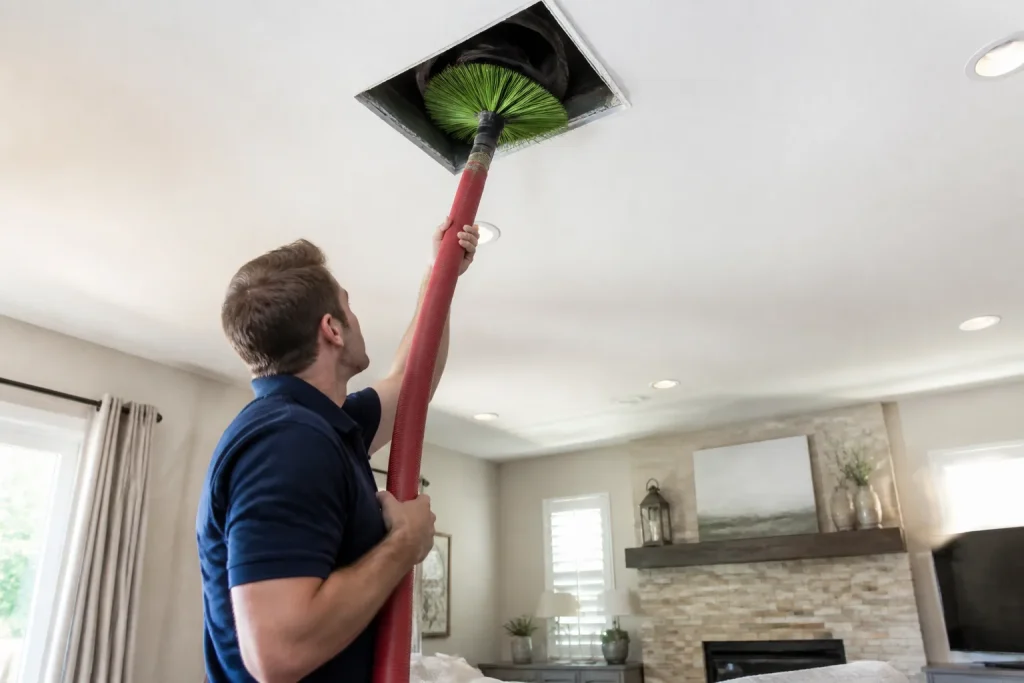
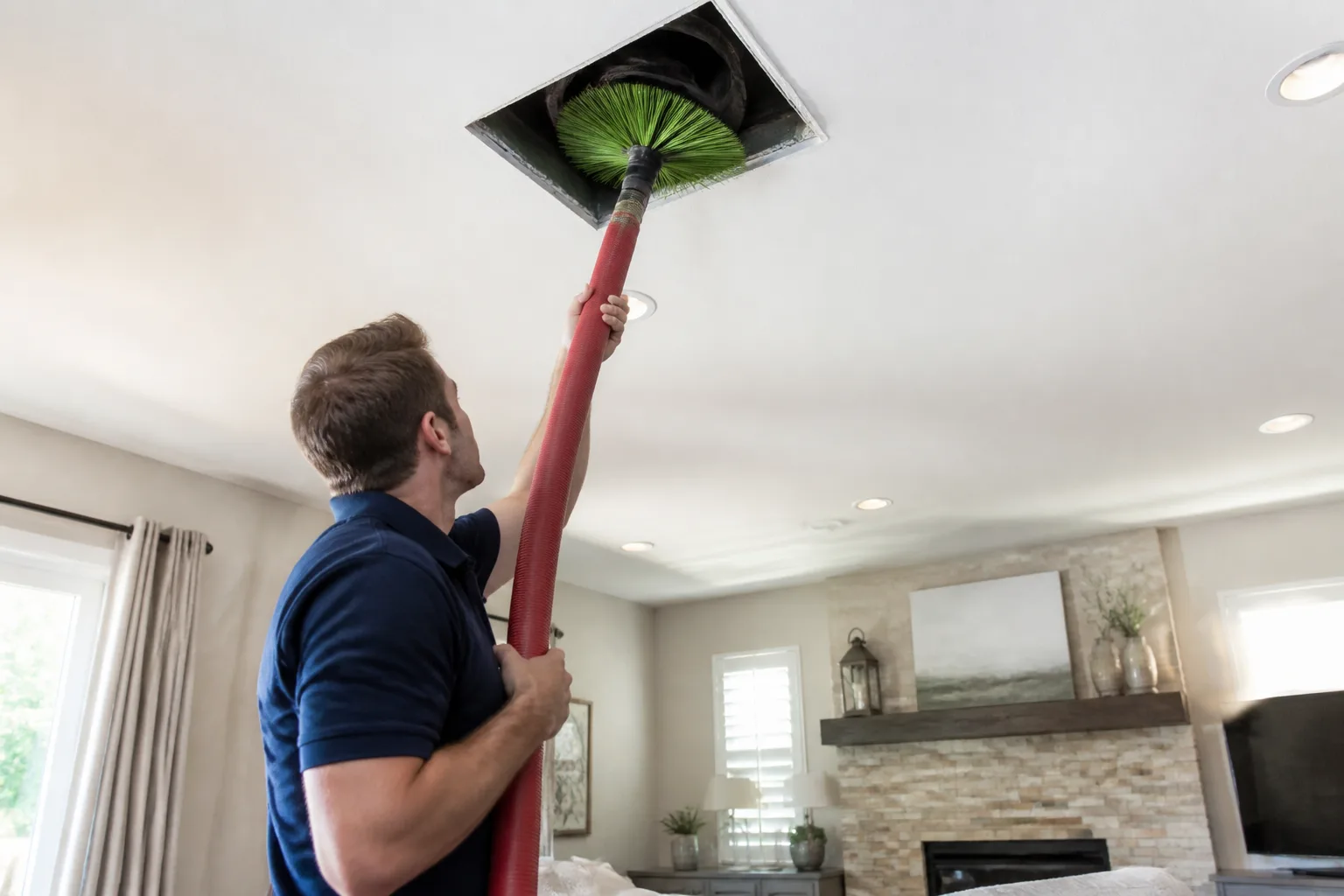
Write this down for two weeks and bring it to the estimate. A technician who can see the pattern will scope the job correctly. We use Rotobrush rotary-brush extraction and Nikro HEPA-rated vacuums rated to capture particles down to 0.3 microns, which means the debris we dislodge stays in the machine rather than recirculating into the room. The cleaning itself is mechanical, but the diagnosis of what to clean – and whether to sanitize afterward – comes from the pattern.
When to Call a Pro
Call a professional when the tissue test shows weak airflow at multiple registers, when a smell is persistent, when you’ve had a renovation, pest, moisture, or smoke event, or when the run cycles and room-temperature spread have clearly worsened. What we don’t recommend is opening the ductwork yourself or reaching into a plenum with a shop vacuum. The systems hold fiberglass insulation, sharp sheet metal edges, and in some cases wiring, and a well-meaning DIY attempt often introduces more contamination than it removes.
If the system is holding pressure and running clean, we’ll tell you so. If it needs air duct cleaning, we’ll scope the job in writing before any work starts. If the ducts themselves are leaking or disconnected, cleaning alone won’t fix the comfort problem – that’s where HVAC cleaning and duct repair and sealing come in. And if you’ve never had the dryer vent looked at, that’s a fire-safety check worth doing while we’re on site: dryer vent cleaning is part of the same service visit in most Salt Lake City homes.
Related services in Salt Lake City: duct cleaning, duct repair and sealing, HVAC coil and blower cleaning, dryer vent cleaning, and air quality sanitizing.
The Bottom Line
The signs that actually point to dirty ductwork are mechanical, not cosmetic. Longer run times, room-to-room temperature spread, rising bills with an unchanged thermostat schedule, weak airflow at the register, event-driven contamination from smoke, inversion, renovation, or pest activity, and allergy symptoms that track with the system running. Dust on a grille tells you almost nothing. Airflow and pressure tell you almost everything.
If you’re in Salt Lake City and need help, Salt Lake City Air Duct Cleaning Pros offers free estimates – call (866) 937-7589. We answer 24/7. Fast dispatch from 7am to 7pm, Sunday through Friday. Our technicians have up to 11 years of experience, and the local pro is licensed and insured as their state requires. You can also start at our Salt Lake City Air Duct Cleaning Pros page.
Frequently Asked Questions
Most Salt Lake City homes don’t need duct cleaning on a fixed schedule – it’s event-driven. Smoke season, inversion winters, renovations, pest activity, and moisture events are the triggers. A home with none of those can often go years between cleanings. A home that just finished a remodel should have the ducts checked soon after. Call (866) 937-7589 for an exact quote – estimates are free.
Typical estimates for a whole-system cleaning in the Salt Lake City area fall in the low hundreds to mid-hundreds of dollars, depending on the number of registers, system size, and how much debris has accumulated. The written estimate sets the final price. We give one flat price per system agreed before work starts, not per-vent pricing that grows as the technician counts. Call (866) 937-7589 for an exact quote – estimates are free.
Cheap quotes usually mean a shop vac and a hose, no containment, and per-vent pricing that balloons on site. A proper cleaning uses rotary-brush extraction and HEPA-rated vacuums rated to capture particles down to 0.3 microns, plus remediation-grade air scrubbing to keep debris out of the room. If the quote is dramatically below the others, ask what equipment is on the truck before you book. Call (866) 937-7589 if you’d like to compare scope – estimates are free.
Ask for before-and-after photos of your own ducts, not stock photos. A legitimate crew will show the return plenum, the blower compartment, and a representative supply run before and after. We also walk you through what we found and what we cleaned so you know the scope. Call (866) 937-7589 for an exact quote – estimates are free.
Written by the team at Salt Lake City Air Duct Cleaning Pros.
Need Air Duct Cleaning Help?
Call Salt Lake City Air Duct Cleaning Pros - the local pro we connect you with is licensed and insured, here with fast help in Salt Lake City.
(866) 937-7589